As the global industry moves from lead-acid to lithium, ROYPOW leads the transition, helping forklift fleet operators increase material handling efficiency, reduce total cost of ownership, and maximize ROI across various applications, including distribution centers, manufacturing plants, and cold storage facilities.
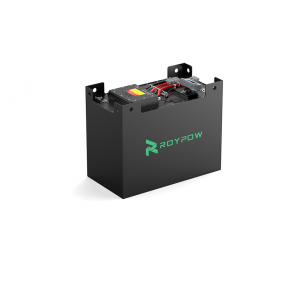
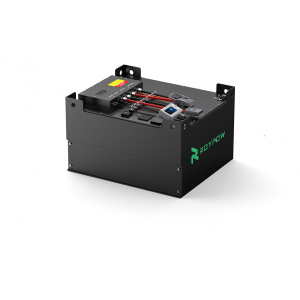
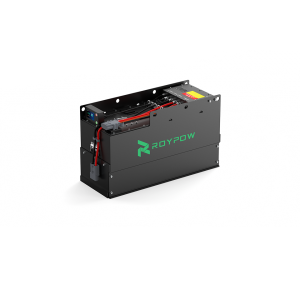
ROYPOW lithium forklift batteries cover 24–80 V, with a maximum of 350 V, supporting Class I, II, and III forklifts from light-duty to heavy-capacity operations. UL- and CE-certified, our batteries offer flexible, customer-specific customization, providing reliable, high-performance power for the US and European forklift markets.
UL Certified
Forklift Battery
DIN Certified
Forklift Battery
24V / 30V / 48V / 80V
Battery
Explosion-Proof
Forklift Battery
Cold Storage
Forklift Battery
Air-Cooled Forklift
Forklift Battery
Liquid-Cooled
Forklift Battery
Forklift Battery TCO Calculator
Compare total cost of ownership: LFP Forklift Battery vs. Lead-Acid Forklift
Battery
Error: Operating hours must be a multiple of 2,000
(e.g., 2,000, 4,000, 6,000).
Typical ownership: 5-10 years
Enter a Warming that does not meet the criteria!
Enter a Warming that does not meet the criteria!
Recommendation: LFP Forklift Battery
LiFePO4 forklift offer the lowest TCO for high-usage operations due to low energy
costs and minimal maintenance.
Potential savings:$10095
over 5 years vs lead-acid forklift battery.
LFP Forklift Battery
$43,805.00
4.38 per hour
Battery Cost$4,155.00
Energy$39,650.00
Maintence$0.00
Advantages
Long lifespan: 3,000–6,000 cycles (2–4× longer than lead-acid) Fast charging: 1–2 hours, supports opportunity charging High efficiency: Stable voltage, no performance drop as battery drains Maintenance-free: No watering, no acid handling Lighter weight: ~50–70% of lead-acid Higher usable capacity: ~90% (vs ~60% for lead-acid)
Disadvantages
Higher upfront cost (though narrowing at higher capacities) Dependent on BMS quality (poor systems can cause issues) Weaker low-temperature performance (may require heating system)
Short lifespan: ~1,200–1,500 cycles Slow charging: 8–10 hours + cooling time High maintenance: watering, cleaning, equalization Lower efficiency: noticeable power drop over time Heavy weight: especially in 80V large-capacity systems (1 ton+) Lower usable capacity: ~60%
Real customer cases: cold storage, rental, multi-shift
Why choose forklift batteries of ROYPOW?
Certified Reliability
Certified to strict UL 2580, IEC 62619, and CE standards, ensuring the highest level of safety, reliability, and quality for peace of mind.
Grade A LFP Cells
Delivers high energy efficiency, stable and consistent power, and excellent thermal stability, reducing the total cost of ownership over the battery’s lifespan.
Long Lifespan
Over 10 years of design life and 3,500+ cycles—two to three times that of lead-acid batteries—ensuring reliable performance while reducing the need for frequent, costly battery replacements.
Zero Maintenance
Requires no watering, cleaning, or electrolyte checks, reducing downtime and operational tasks, and saving time and labor costs.
Drop-in Replacement
Designed to fit existing forklifts by conforming to BCI and DIN size standards, requiring no modifications for quick, hassle-free replacement.
Ultra-Safe
Effectively prevents thermal runaway with the integrated fire suppression system, ensuring maximum safety for operators and equipment, minimizing potential downtime and costs.
Powered by Advanced Technology
Intelligent BMS
Protects the forklift battery while maximizing runtime, extending lifespan, and reducing energy and replacement costs.
Real-Time Monitoring of Battery Status
Real-Time Communication Through CAN
Multi-Level Safety Protection
Full-Time Cell Balancing
Charge & Discharge Efficiency Optimization
Fault Alarm
4G Cloud Platform
Manage and monitor the forklift fleet anytime, anywhere, while reducing downtime, maintenance costs, and improving operational efficiency.
Smart Management via App & Web
Real-Time Monitoring of Battery Status
SIM-Free Network Connectivity in 135+ Countries
Remote Diagnosis and Maintenance
Equipment Position Tracking & Locking
OTA Updates
ROYPOW, Your Trusted Partner for Forklift Batteries
R&D Strength
Our team of 200+ experts, with an average of 20 years' experience in the new energy sector, holds 36O+ patents and drives innovation in high-performance lithium-ion forklift battery solutions.
Advanced Manufacturing
Two advanced factories in China (8Gwh) and lndonesia (2GWh), featuring fully automated production lines and smart manufacturing management systems, ensure high-quality forklift batteries and a reliable global supply.
Global Presence & Support
With 17 subsidiaries and offices worldwide, ROYPow ensures on-time delivery and provides responsive, comprehensive local technical and service support for all forklift fleets, guaranteeing seamless operation and long-term reliability.
Applications
High-Performance Forklift Batteries Built for All Work Environments
Warehouse & Distribution Centers
Charge quickly during breaks and shift changes with no maintenance or battery swaps, maximizing uptime for efficient, high-volume material handling.
Ports & Yards
Designed for demanding outdoor operations, providing sustained high performance for heavy loads while ensuring long-term reliability in harsh port and yard environments.
Cold Storage & Refrigerated Warehouses
Operates efficiently at temperatures down to -40℃, enhancing equipment availability and extending battery service life in cold environments, while reducing long-term operating costs.
Hazardous & Explosive Environments
Certified lithium-ion forklift batteries feature multi-layer safety protection to minimize risk while maintaining reliable, safe operation in flammable and explosive environments.
High-Temp, Multi-Shift & Heavy-Duty Environments
ROYPOW liquid cooling and air cooling technology optimize temperature management for consistent performance, ensuring reliable operation in extreme conditions.
Compatible with Leading Forklift Brands
Designed for seamless integration with most major forklift models.
Case
Empowering Yale, Hyster & TCM Forklift Operations in Europe with ROYPOW Lithium Forklift Batteries
DATEMay-30, 2025
LOCATIONGERMANY
Fast Delivery & Local Support: How ROYPOW Lithium Forklift Batteries Empower a Linde Dealer in Poland
DATEMar 10, 2026
LOCATIONPoland
From Lead-Acid to Lithium: Reducing Maintenance and Improving Efficiency for a Yale Forklift in Germany
DATEApr 24, 2026
LOCATIONGERMANY
ROYPOW Lithium Battery Training at Hyster Czech Republic A Step Forward in Forklift Technology-0
DATEDec 13, 2024
LOCATIONCzech Republic
ROYPOW Lithium Batteries Power Reliable Forklift Operations in Cold Environments
DATEJun 18, 2026
LOCATIONItaly
1616
Warehouses Worldwide
Fast Shipping and Localized Support
China
South Korea
United States
(CA / TX / GA / FL / IN)
United Kingdom
Germany
Netherlands
Japan
Indonesia
Brazil
Australia
Become a ROYPOW Forklift Battery Dealer
ROYPOW has established 17 subsidiaries and offices worldwide, enabling it to quickly provide you with service and technical support globally.
When the battery level drops below 10%, our forklift battery will alert to prompt charging. Please follow the correct practices to recharge it.
2. Who can charge and change batteries for electric forklifts?
Only well-trained and experienced personnel are allowed to charge and change forklift batteries. Improper handling without adequate training or instructions may lead to battery damage or other potential hazards.
3. How long does it take to charge a forklift battery?
Charging time may vary depending on several factors, such as the battery type, battery capacity, the amperage of the charger, and the remaining capacity. Typically, it takes 1 to 2 hours to charge a forklift truck battery from ROYPOW.
4. How long do forklift batteries last?
ROYPOW forklift batteries feature a service life of up to 10 years and a cycle life of over 3,500 times. Our batteries may have an extended life cycle with proper care and maintenance.
5. How much sulfuric acid is in a forklift battery?
Typically, a lead-acid forklift battery contains approximately 20% sulfuric acid by weight.
6. What steps should I take before charging a forklift battery?
First, turn off the forklift and disconnect the battery. Inspect the charger, input cable, output cable, and output socket.
Second, ensure that the AC input terminal and DC output terminal are securely and correctly connected. Check for any loose connections. Verify whether the air switch is disconnected. Toggle the air switch up and turn on the charger. Charging will automatically start at this point and stop once the forklift battery is fully charged.
7. How much does a forklift battery weigh?
There are a variety of sizes for forklift batteries. A ROYPOW 24-volt forklift battery that is 1,120 amp-hours forklift can weigh more than 9,000 lbs. Before installing a new or different forklift battery, check both the forklift nameplate and battery service weight to make sure that the proper weight battery is being used. A forklift battery of the wrong weight can change the center of gravity and cause equipment to upset.
8. When should water be added to a forklift battery?
All ROYPOW forklift batteries are lithium-ion batteries instead of lead-acid batteries, eliminating the need for water filling. For traditional lead-acid batteries, the ideal time to add water is after the battery has been fully charged since the water level rises during charging, and filling water before charging could lead to overflow.
9. What is the IP rating of ROYPOW batteries?
Standard battery: IP65
10. How can I check the residual capacity of the battery after 1–2 years?
Via the forklift battery display or the ROYPOW app (connected via 4G module).
11. Are ROYPOW chargers multi-voltage compatible?
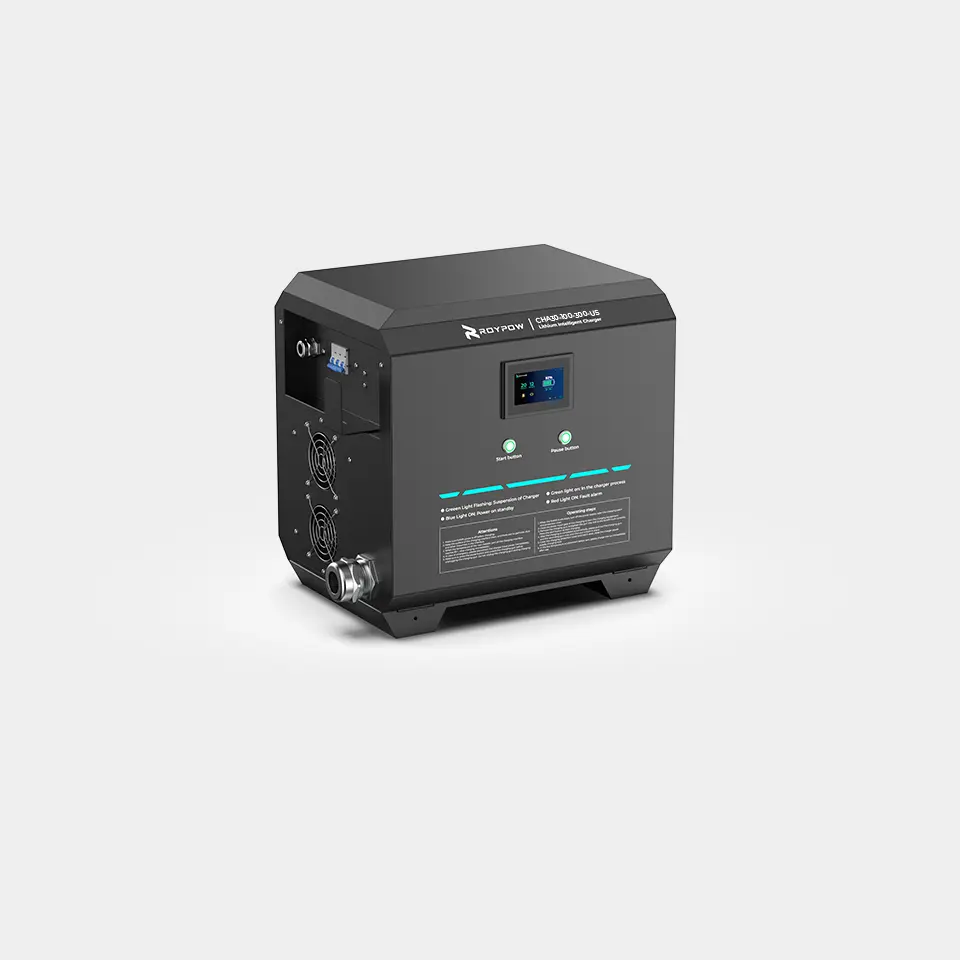
Yes, our chargers support global voltage platforms (e.g., 36V/48V/80V). Note: 24V batteries use the vehicle’s onboard charger.
12. Can ROYPOW batteries be installed in AWP (e.g., Haulotte HA 15 IP)?
Yes, but we need details like voltage, capacity, weight, dimensions, and discharge plug model for assessment.
13. Are ROYPOW batteries compatible with Heli or other forklift brands?
Yes, they are suitable for all forklift brands.
14. Can batteries be ordered without counterweights?
Yes, ROYPOW lithium forklift batteries can be customized without counterweight blocks.
15. Can ROYPOW chargers charge non-ROYPOW lithium batteries?
Yes, they are compatible with most lithium battery brands.
16. What maintenance is required for lithium batteries?
Fully charge/discharge every 6 months to balance cells. No regular watering or equalization like lead-acid batteries.
17. What happens to batteries after 5 years? Does ROYPOW collect them?
Yes! We offer recycling programs with costs covered by ROYPOW, though policies vary by market.
18. Do ROYPOW batteries have telemetry systems for monitoring? What is the input voltage for ROYPOW chargers?
No, ROYPOW lithium batteries and chargers are designed for safe indoor use without ventilation requirements. ROYPOW battery chargers are compatible with global voltage standards (specifics available upon request).
19. What are the advantages of switching from lead-acid to lithium when using forklift truck batteries?
Lithium-ion forklift truck batteries deliver higher energy density and more stable power output, reducing downtime associated with watering, equalization, and swapping. They are maintenance-free, more compact and often lighter than equivalent lead-acid batteries, enabling longer operational hours, faster charging, and safer, leak-free operation.
20. Can a lithium electric forklift battery from one brand be used as a retrofit in a different brand’s forklift?
Yes. Many electric forklift battery systems (especially from reputable forklift battery manufacturers) are designed to meet common standards (voltage, size, and connection type). As long as you match the voltage, dimensions, and output plug to your forklift’s original specification, a lithium battery should integrate without requiring major modifications.
21. Are industrial forklift batteries, like those for heavy-duty warehouse or port use, available in lithium versions, and what should I check when selecting them?
Yes, many industrial forklift batteries are now offered in lithium versions suitable for heavy-duty applications such as warehouses, shipping terminals, cold storage, and manufacturing. When selecting, make sure to verify the required voltage, capacity (Ah or kWh), compatibility with your lift truck’s make/model, battery weight (to avoid upsetting the center of gravity), and whether the BMS supports multi-shift, high-duty cycles.
22. What should I expect when choosing a new fork truck battery in terms of service life and total cost of ownership compared to legacy lead-acid batteries?
A high-quality lithium fork truck battery typically offers significantly longer service life, often 8–10 years or more, compared to lead-acid batteries. Because lithium batteries rarely require maintenance (no watering, no acid handling) and support fast recharging and multi-shift operations, the total cost of ownership (labor, downtime, maintenance, replacement) tends to be lower over the battery’s lifetime.
23. How many cycles should an electric forklift battery from modern forklift battery manufacturers be expected to deliver, and what factors affect this?
Many of the newer lithium-ion electric forklift batteries from top manufacturers are rated for thousands of cycles (often 3,000+ to 4,000+), assuming proper use and charging. Factors that affect cycle life include depth of discharge, charge/discharge rate, ambient temperature, maintenance practices (e.g., keeping the battery within recommended temperature/voltage ranges), and load profile (how heavily the forklift is used on each shift).
24. If I operate a fleet of electric fork truck batteries, what fleet-management benefits might lithium batteries offer over conventional options?
For a fleet, lithium electric fork truck batteries offer consistent voltage and power output across shifts, reduced downtime (thanks to fast charging and no battery swapping), lower maintenance overhead (no watering or acid-related maintenance), and easier battery asset management (with built-in BMS, remote diagnostics, and often tools for monitoring battery health). This can increase uptime, reduce labor cost, and improve overall operational efficiency.
25. What is the difference between forklift truck batteries and traditional industrial battery packs?
Forklift truck batteries are specifically engineered to handle frequent starts, stops, heavy lifting, and multi-shift operations. Unlike general industrial battery packs, forklift truck batteries must deliver high current output, vibration resistance, thermal protection, and compatibility with counterbalance requirements. Lithium forklift truck batteries further enhance performance with faster charging and zero maintenance.
26. How do I select the correct fork truck battery for my specific forklift model?
To select the right fork truck battery, you must match the voltage (e.g., 24V, 36V, 48V, 80V), physical battery compartment dimensions, connector type, required capacity (Ah or kWh), and counterweight specifications. A professional forklift battery manufacturer can help tailor the exact configuration for your brand and model.
27. What factors affect the performance of an electric forklift battery in daily warehouse operations?
Electric forklift battery performance is affected by load weight, operating temperature, shift length, charging habits, and equipment efficiency. Poor charging practices and extreme temperatures can reduce usable capacity. Advanced lithium electric forklift battery systems automatically regulate these variables through built-in battery management systems (BMS).
28. Are electric fork truck batteries safe to use in cold storage and freezer environments?
Yes, many electric fork truck batteries are specially designed for cold storage environments. Industrial lithium batteries can operate in sub-zero temperatures with integrated self-heating technology, corrosion-resistant enclosures, and temperature-controlled BMS systems to maintain full charging capability in freezer warehouses.
29. What industries rely most on industrial forklift batteries today?
Industrial forklift batteries are essential across logistics, manufacturing, ports, food processing, cold storage, aerospace, pharmaceuticals, and automotive production. Any operation that depends on continuous material movement benefits from high-performance industrial forklift battery systems with fast charging and long duty cycles.
30. How does fast charging impact electric forklift battery longevity?
With lead-acid systems, fast charging often shortens battery life. However, lithium electric forklift batteries are engineered to handle high charging currents safely. Controlled fast charging actually improves uptime without damaging the battery, allowing opportunity charging during short breaks or shift changes.
31. What certifications should I look for when evaluating forklift battery manufacturers?
Reliable forklift battery manufacturers should offer products certified to UL, CE, UN38.3, and ISO standards. These certifications confirm compliance with electrical safety, transportation safety, manufacturing quality systems, and international performance regulations, especially critical for industrial forklift battery deployments.
32. Can a single electric forklift battery support multi-shift warehouse operations?
Yes. Unlike lead-acid batteries that require full discharge and long cool-down periods, lithium electric forklift batteries allow opportunity charging. One battery can power a forklift continuously across multiple shifts with short charging sessions during breaks, eliminating the need for battery swapping rooms.
33. What maintenance is required for modern electric fork truck batteries?
Modern lithium electric fork truck batteries require no watering, no acid checks, no equalization charging, and no corrosion cleaning. Routine maintenance is limited to basic inspections of connectors and software diagnostics, reducing labor costs and safety risks dramatically compared to lead-acid systems.
34. How do forklift battery manufacturers design batteries for fleet-level management?
Advanced forklift battery manufacturers integrate smart BMS platforms, CAN communication protocols, cloud monitoring, and remote diagnostics into their industrial battery systems. This allows fleet managers to track charge cycles, battery health, temperature, uptime, and predictive maintenance across hundreds of forklifts in real time.
Read MoreRead Less
Subscribe to our newsletter
Get the latest ROYPOW's progress, insights and activities on renewable energy solutions.
Tips: For after-sales inquiry please submit your information here.
Start Your FREE Subscription Today!
Get the latest ROYPOW's progress, insights and activities on renewable energy solutions.












 Intelligent BMS
 4G Cloud Platform


 Empowering Yale, Hyster & TCM Forklift Operations in Europe with ROYPOW Lithium Forklift BatteriesDATE May-30, 2025LOCATION GERMANY
 Fast Delivery & Local Support: How ROYPOW Lithium Forklift Batteries Empower a Linde Dealer in PolandDATE Mar 10, 2026LOCATION Poland
 From Lead-Acid to Lithium: Reducing Maintenance and Improving Efficiency for a Yale Forklift in GermanyDATE Apr 24, 2026LOCATION GERMANY
 ROYPOW Lithium Battery Training at Hyster Czech Republic A Step Forward in Forklift Technology-0DATE Dec 13, 2024LOCATION Czech Republic
 ROYPOW Lithium Batteries Power Reliable Forklift Operations in Cold EnvironmentsDATE Jun 18, 2026LOCATION Italy